
What Are Mold Spores? Mold Statistics and Facts for 2026
Research Highlights: Mold spores are common in indoor and outdoor air, but the biggest household risk occurs when spores land on damp materials and begin to grow.
- Mold spores are naturally present in both indoor and outdoor air, and EPA notes they are usually too small to see without magnification.
- Mold may begin growing indoors when spores land on wet surfaces, which is why moisture control matters more than trying to eliminate every spore.
- Water-damaged areas and items should be dried within 24 to 48 hours to help prevent mold growth, according to guidance from the EPA and CDC.
- Indoor humidity should ideally stay between 30% and 50%, and EPA recommends keeping it below 60% when possible.
- CDC says mold exposure may cause no symptoms in some people, while others may experience stuffy nose, sore throat, coughing, wheezing, burning eyes, or skin rash.
- People with asthma, mold allergies, weakened immune systems, or chronic lung disease can face higher health risks from mold exposure than the general population.
- EPA says it is impossible to remove all mold and mold spores indoors, so prevention depends on controlling moisture and removing active growth.
- No federal standard defines an acceptable indoor mold spore level, and EPA says sampling is usually unnecessary when visible mold is already present.
- The 2023 American Housing Survey reported 3.9 million U.S. homes with mold in the last 12 months, plus millions more with inside or outside water leakage.
- Mold odor can suggest hidden mold growth, and EPA says a musty smell should be investigated even when visible mold is not obvious.
What Are Mold Spores?
Mold spores are tiny reproductive cells released by mold. They move through the air, settle on surfaces, and may begin growing when they land on damp materials. Mold spores are not unusual by themselves. They become a household problem when moisture, organic material, and poor drying conditions allow mold growth indoors.
EPA explains that molds reproduce through tiny spores that float through indoor and outdoor air. These spores are usually invisible without magnification. Spores can enter a home through doors, windows, vents, HVAC systems, clothing, shoes, bags, and pets.
The important distinction is this: mold spores are normal, but indoor mold growth should be avoided. A clean home can still have background mold spores. The goal is not sterilization. The goal is to prevent damp surfaces from turning spores into active mold growth.
Featured answer
Mold spores are microscopic particles that molds release to reproduce. They are found naturally in outdoor and indoor air. They become a concern indoors when they land on wet or damp surfaces and begin growing on materials such as wood, paper, carpet, drywall, insulation, fabric, dust, or upholstery.
Are Mold Spores Everywhere?
Yes. Mold spores are naturally present in indoor and outdoor air. This does not mean every home has a mold problem. The risk rises when spores find moisture, poor ventilation, or water-damaged materials.
CDC states that there is always some mold around and that mold can enter homes through open doors, windows, vents, heating and air conditioning systems, clothing, shoes, bags, and pets. EPA similarly describes molds as part of the natural environment.
This matters for homeowners because “getting rid of mold spores” is often the wrong goal. EPA says it is impossible to get rid of all mold and mold spores indoors. A better goal is to remove visible mold, dry wet materials quickly, fix leaks, improve ventilation, and keep humidity under control.
Where Do Mold Spores Come From?
Mold spores come from mold colonies indoors and outdoors. Outdoors, molds help break down dead organic matter such as leaves, trees, and debris. Indoors, spores may come from outdoor air, damp building materials, bathrooms, basements, carpets, dust, HVAC contamination, water leaks, or hidden mold behind walls.
Common entry points include:
- Open doors and windows
- Heating and cooling systems
- Vents
- Shoes
- Clothing
- Bags
- Pets
- Damp basements
- Wet carpets
- Leaking roofs, walls, or pipes
- Condensation around windows or cold surfaces
Spores alone do not guarantee growth. EPA notes that mold needs water or moisture to grow. That is why a dry surface may collect spores without developing visible mold, while a wet wall, damp carpet, or humid bathroom can become a growth area.
Are Mold Spores Dangerous?
Mold spores can be a health concern, especially for sensitive people, but risk varies by person, exposure level, and indoor conditions. CDC says exposure to damp and moldy environments may cause a variety of health effects, or none at all. People with asthma, allergies, weakened immune systems, or chronic lung disease face higher risk.
Potential symptoms reported by CDC and EPA include:
- Stuffy nose
- Sore throat
- Coughing
- Wheezing
- Burning, red, or itchy eyes
- Skin rash
- Asthma symptoms in people with asthma
- More severe reactions in some occupational or high-exposure settings
The best phrasing is careful: mold exposure is linked to respiratory and allergic symptoms, but it does not affect everyone the same way. It is also not usually necessary to identify the exact mold type before acting. CDC says all molds should be treated the same with respect to potential health risks and removal.
What Are Mold Spores in the Air?
Mold spores in the air may cause allergy-like or respiratory symptoms in sensitive people, including stuffy nose, coughing, wheezing, sore throat, irritated eyes, or skin rash. Some people have no symptoms. People with asthma, mold allergies, chronic lung disease, or weakened immune systems may be more vulnerable.
The phrase “mold spores in air symptoms” is a high-intent search because people often notice symptoms before they find visible mold. But symptoms alone cannot prove that mold is the cause. Dust, pollen, pets, smoke, cleaning chemicals, pests, and poor ventilation can cause similar irritation.
A practical approach is to look for environmental clues:
- Musty smell
- Visible spots on walls, ceilings, grout, or window frames
- Recent leaks or flooding
- Condensation on windows or pipes
- Damp carpet or upholstery
- Bathroom mold that returns after cleaning
- Basement or crawlspace moisture
- HVAC odors or visible moisture near vents
If symptoms are persistent or severe, a health professional is the right source for medical advice. For the home itself, visible mold or mold odor should be investigated and the moisture source should be fixed.
Can Mold Spores Travel on Clothing?
Yes. CDC says mold in outdoor air can be brought indoors on clothing, shoes, bags, and pets. In most homes, this is normal and does not mean clothing is dangerous. Mold becomes a bigger issue when clothing is damp, stored in humid spaces, or contaminated by active mold growth.
For everyday clothing, normal laundering and drying are usually enough. The larger risk comes from storing damp items in piles, closets, basements, laundry baskets, or bags where moisture remains trapped.
Clothing and mold risk table
Situation | Mold spore risk | What matters most |
|---|---|---|
Dry clothing worn outdoors | Low and normal | Spores can hitchhike, but usually do not grow without moisture |
Damp towels or gym clothes left in a pile | Higher | Moisture and organic material support growth |
Clothing stored in a humid basement | Higher | Long-term humidity can support mold growth |
Clothes exposed to visible mold | Higher | Wash, dry fully, and inspect storage conditions |
Clothing with persistent musty odor | Possible hidden moisture issue | Investigate the storage area, not just the fabric |
What Does Black Mold Spores Look Like?
Black mold spores usually cannot be seen individually without magnification. What people call “black mold” is usually visible mold growth, not individual spores. CDC identifies Stachybotrys chartarum as a greenish-black mold, but visual identification alone is not reliable enough to prove the species.
This is an important point because black mold searches are often fear-driven. A black, dark green, gray, or brown spot on a wall may be mold, but color does not confirm the exact type or toxicity. CDC says it is not necessary to determine what type of mold is growing in a building. If mold is present, it should be removed and the moisture problem should be fixed.
What Do Mold Spores Smell Like?
Mold spores themselves are not usually identified by smell. Mold growth can produce musty or unpleasant odors. EPA explains that microbial volatile organic compounds, or mVOCs, can create the moldy or musty smell associated with mold growth.
A musty smell matters because it can point to hidden mold. EPA says a moldy odor suggests mold is growing in the building and should be investigated. Common hidden sources include:
- Behind drywall
- Under carpet or carpet padding
- Behind wallpaper
- Inside cabinets
- Around leaking pipes
- Above ceiling tiles
- Near HVAC components
- Behind furniture placed against exterior walls
- In damp basements or crawlspaces
A musty smell after cleaning may mean the surface was cleaned but the underlying moisture source was not fixed.
How Do You Get Rid of Mold Spores in a Home?
You cannot fully remove all mold spores from a home. EPA says some mold spores will remain in indoor air and house dust. The practical goal is to remove visible mold, reduce dampness, clean dust, improve ventilation, dry wet materials quickly, and fix the moisture source.
Featured answer
To reduce mold spores indoors, remove visible mold, clean dust, dry wet materials within 24 to 48 hours, fix leaks, improve ventilation, and keep indoor humidity low. EPA says it is impossible to remove all mold spores indoors, so prevention depends on moisture control rather than sterilizing the home.
What works better than trying to “kill spores”
- Fix roof, wall, plumbing, or appliance leaks.
- Dry wet areas quickly after spills, leaks, or flooding.
- Keep indoor humidity below 60%, ideally 30% to 50%.
- Use bathroom fans during and after showers.
- Vent dryers outdoors.
- Avoid carpet in damp bathrooms or basements.
- Remove or replace porous materials that stayed wet too long.
- Clean visible mold from hard surfaces with detergent and water.
- Do not rely on air fresheners to cover mold odor.
How Do You Get Rid of Mold Spores in a Bathroom?
Bathroom mold usually returns when humidity, condensation, or poor ventilation remain unresolved. Cleaning can remove visible mold from hard surfaces, but long-term control depends on lowering moisture after showers, drying surfaces, repairing leaks, and improving airflow.
Bathrooms are common mold locations because they combine:
- Warm air
- Frequent moisture
- Condensation
- Organic residue from soap and dust
- Grout lines and porous surfaces
- Poor ventilation
- Wet towels and bath mats
Bathroom mold prevention table
Bathroom issue | Why it matters | Better control step |
|---|---|---|
Fan not used after showers | Moist air lingers | Run the fan during and after bathing |
No fan or weak fan | Moisture stays trapped | Open a window when practical or improve ventilation |
Wet towels left piled up | Damp fabric can support odor and growth | Hang towels so they dry fully |
Mold returns on grout | Moisture and residue remain | Clean residue, dry surfaces, and improve airflow |
Caulk is stained or failing | Water may get behind surfaces | Replace damaged caulk and check for leaks |
Musty smell after cleaning | Hidden moisture may remain | Inspect under sinks, walls, vents, and flooring |
Mold Spore Statistics Homeowners Should Know
Statistic or finding | What it means for homes |
|---|---|
Mold spores are naturally present indoors and outdoors | A spore-free home is not realistic |
Mold spores are usually invisible without magnification | Visible mold is growth, not individual spores |
Mold needs water or moisture to grow | Moisture control is the main prevention strategy |
Wet materials should be dried within 24 to 48 hours | Fast drying reduces the chance of growth |
EPA recommends humidity below 60%, ideally 30% to 50% | A humidity meter can help homeowners track risk |
CDC says mold exposure may cause symptoms or none at all | Health effects vary by person |
EPA says no federal mold spore limits exist | Mold testing is not always useful for homeowners |
3.9 million U.S. homes reported mold in the 2023 American Housing Survey | Mold is a measurable housing quality issue |
11.2 million homes reported water leakage from inside the home in the 2023 AHS | Leaks create conditions where mold can grow |
11.8 million homes reported water leakage from outside the home in the 2023 AHS | Roof, wall, basement, and exterior leaks matter |
Why Mold Spores Become a Problem Indoors
Mold spores become a problem indoors when three conditions overlap:
- Spores are present.
- Moisture is present.
- A surface provides material for mold to grow on.
Many household materials can support mold if they stay damp. EPA and CDC list examples such as paper, cardboard, ceiling tiles, wood, dust, paint, wallpaper, insulation, drywall, carpet, fabric, and upholstery.
The pattern is simple: spores are common, moisture is the trigger, and delayed drying gives mold time to grow.
What Indoor Humidity Level Helps Prevent Mold?
EPA recommends keeping indoor humidity below 60% when possible, ideally between 30% and 50%. CDC recommends keeping humidity no higher than 50% all day long. A small humidity meter can help homeowners identify rooms where moisture risk is higher.
Rooms that often need humidity monitoring include:
- Bathrooms
- Basements
- Laundry rooms
- Kitchens
- Crawlspaces
- Bedrooms with condensation
- Rooms with poor airflow
- Areas near leaky windows or exterior walls
Humidity matters most when it stays elevated. A bathroom may briefly spike after a shower, but the risk rises when damp air lingers and surfaces remain wet.
When Should Mold Be Cleaned Up Quickly?
Mold should be addressed quickly when there is visible growth, a persistent musty odor, recent water damage, or damp porous materials. EPA says water-damaged areas and items should be dried within 24 to 48 hours to prevent mold growth.
Fast action is especially important after:
- Plumbing leaks
- Roof leaks
- Flooding
- Appliance overflows
- Sewage backups
- Wet carpet
- Damp drywall
- Basement water intrusion
- Window condensation that keeps returning
The longer mold grows, the more likely it is to damage materials. EPA notes that molds gradually destroy the things they grow on.
Is Mold Testing Needed?
Usually not when visible mold is already present. CDC does not recommend routine mold testing, and EPA says sampling is unnecessary in most cases if visible mold growth is present. EPA also notes that no federal limits have been set for mold or mold spores in indoor air.
Testing may be useful in some professional investigations, especially when hidden mold, insurance disputes, workplace exposure, or remediation verification is involved. For most homeowners, visible mold plus moisture is already enough reason to act.
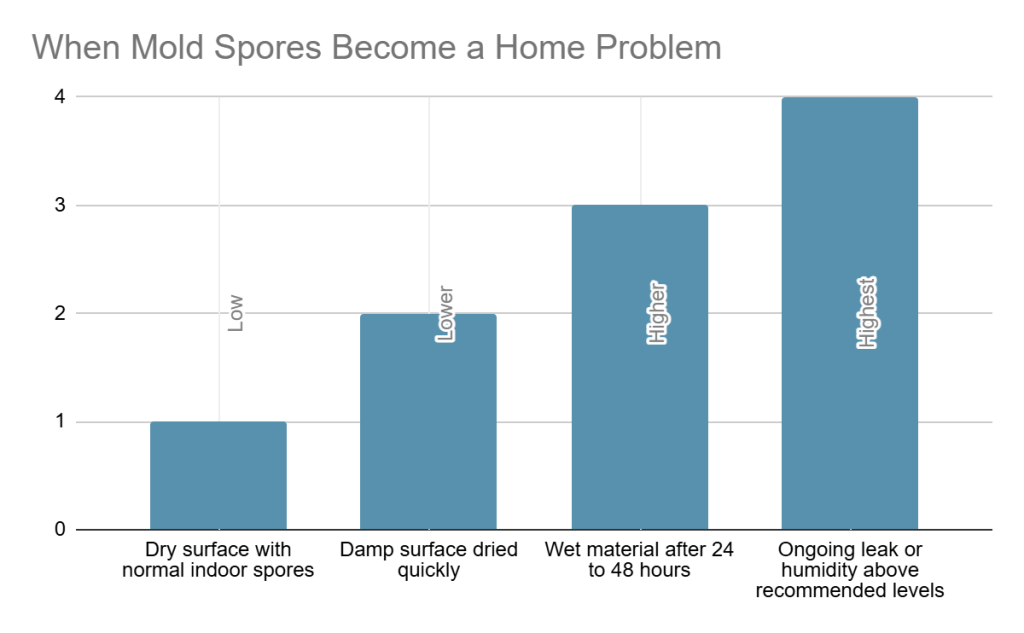
Mold Risk Rises With Moisture and Time
Mold spores are common indoors, but growth risk rises when moisture remains long enough for spores to colonize building materials.
Key Takeaway
Mold spores are not rare, and they cannot be fully eliminated from indoor air. The real household issue is moisture. Homeowners can reduce mold risk by drying wet materials within 24 to 48 hours, keeping humidity low, fixing leaks, improving ventilation, removing visible mold, and investigating musty odors.
Sources
- CDC – “Mold” – https://www.cdc.gov/mold-health/about/index.html
- EPA – “What Are Molds?” – https://www.epa.gov/mold/what-are-molds
- EPA – “A Brief Guide to Mold, Moisture and Your Home” – https://www.epa.gov/mold/brief-guide-mold-moisture-and-your-home
- EPA – “What Does Mold Smell Like?” – https://www.epa.gov/mold/what-does-mold-smell
- CDC – “Facts About Stachybotrys chartarum” – https://www.cdc.gov/mold-health/data-research/facts-stats/index.html
- Park, J. H. and Cox-Ganser, J. M. – “NIOSH Dampness and Mold Assessment Tool:
- Documentation and Data Analysis of Dampness and Mold-Related Damage in Buildings and Its Application” – https://www.mdpi.com/2075-5309/12/8/1075
- U.S. Census Bureau and HUD – “2023 AHS Infographic: Housing Quality” – https://www.census.gov/content/dam/Census/library/visualizations/2024/demo/2023_AHS-Housing%20Qualities_Final%28tagged%29.pdf